
Plant Construction Cost Indexes
What do Plant Construction Cost Indexes measure?
Plant Construction Cost Indexes (IC Indexes) are monthly composite indicators that reflect the relative cost of building a process plant in a given country at a specific point in time. A "composite indicator" is a single index that combines several distinct cost components into one figure. By condensing labor, materials, logistics, and broader economic conditions into a single value, IC Indexes make construction-cost levels comparable across countries and across time.
How is the index broken down for the United States?
The headline IC Index is published for every covered country. For the United States, the index additionally resolves its materials component into seven equipment sub-categories, giving a more detailed view of where construction-cost movements originate:
- Heat exchangers and tanks
- Process machinery
- Pipes, valves, and fittings
- Process instruments
- Pumps and compressors
- Electrical equipment
- Structural materials
This equipment-level breakdown is published only for the United States version; country editions outside the United States publish the headline index alone. The underlying Plant Construction Cost Index series is available in the assessments catalog.
What is the January 2000 = 100 baseline?
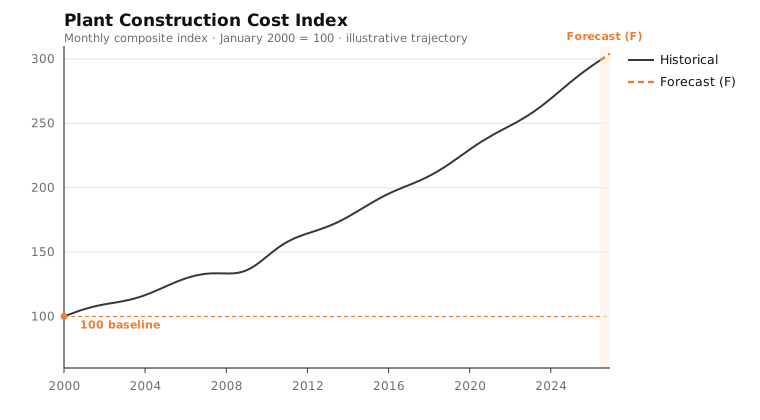
Each IC Index is normalized so that its value for January 2000 is set to 100, and every other monthly value is expressed relative to that reference point. An index of 150, for example, indicates that construction cost is 50% higher than the January 2000 baseline. The fixed base year provides a stable reference for measuring change, and each country's index is expressed in that country's local currency.
How is the index used to escalate capital costs?
The IC Index is used to escalate a capital cost estimate over time, adjusting a figure developed in one period to a current basis. The ratio between the index value at the target date and the index value at the estimate's original date gives the escalation factor applied to the cost. The same index series also supports comparison of capital cost trends across periods and, because of its country coverage, across locations. Each index additionally includes a forecast extending about six months ahead, labeled Forecast (F), enabling forward-looking budget adjustments before final investment decisions. Plotted over time, the series traces a single ascending path from the January 2000 = 100 baseline through the present, with the trailing six months drawn as the projected Forecast (F) segment rather than settled historical values.