

How Prices and Costs Are Assessed
Which five approaches turn data into prices?
Intratec assesses prices and costs through five complementary approaches:
- Trade-based — derived from official government trade statistics.
- Formula-based — calculated from related commodity prices and economic variables using regression models.
- Freight-based — derived by adjusting an existing assessment for freight and insurance.
- Manufacturing-cost-based — estimated from the operating costs of producing a commodity.
- Compiled — built from validated public-source price series.
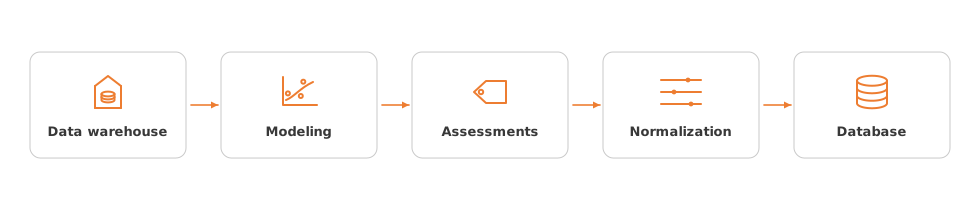
Whichever approach applies, the modeled output passes through normalization before it reaches the published database, so every assessment lands on a common, comparable basis:
When are the trade-based and formula-based approaches used?
The trade-based approach draws on official government trade statistics and is the most common choice when trade data is available, timely, and suitable for the targeted specification (the exact grade and form being priced). It produces two output formats: a unit value (total trade value divided by total quantity, with no statistical treatment) and a transaction price (filtered with minimum-volume thresholds and outlier detection to reflect a mid-market level). Clustering groups comparable trades so that mixing different deal sizes or grades does not distort results.
The formula-based approach is used when a commodity's price moves predictably with measurable drivers. It models prices from related commodity prices and economic variables, such as currency exchange rates and economic indicators, through regression models.
When are freight-based and manufacturing-cost approaches chosen?
The freight-based approach applies when an assessment already exists at one location and a value is needed at another. A netback subtracts freight and insurance from a destination price to give the value at the loading terminal; a netforward adds freight and insurance to a loading price to give the value at the destination terminal.
The manufacturing-cost-based approach is chosen when market prices are scarce but production economics are known. It estimates value from the operating costs of producing the commodity: raw materials, utilities, labor, maintenance, and facility overhead.
What is a compiled series, and how is an approach selected?
A compiled series is built from multiple public-source price series that are statistically validated, cleaned of anomalies, and averaged over the month into a single figure — the approach used wherever several such public series exist and a validated monthly average represents the market. Selecting which of the five approaches applies to a given commodity and location weighs three conceptual factors: data availability, timeliness, and suitability for the targeted specification. The trade-based approach is preferred wherever suitable trade data exists; compiled and the other approaches step in where trade data does not fit the market. The weighing is deliberately conceptual rather than scored — there is no published ranking or error rate per approach, since the right choice depends on what each market actually offers rather than a fixed formula.
What role do analyst estimates play in modeling?
When the available inputs are insufficient, inadequate, or unsuitable for a representative assessment, qualified analysts estimate values from a wide range of factual market information: related assessments, producer references, deal reports, and supply and demand fundamentals. Analysts verify all data used and may propose adjustments to the mathematical models, so estimation remains a disciplined modeling step rather than a free-form judgment.
Estimates are always distinguishable from verified official statistics: every value carries a data-status label, defined on the Data Status Labels page. When and why gaps arise in the first place — source lags, unavailable or discontinued sources — is covered on the Source Timing and Coverage page.