

What the Report Measures
Open the Full Methodology (PDF)
What is Industry Economics & Competitiveness?
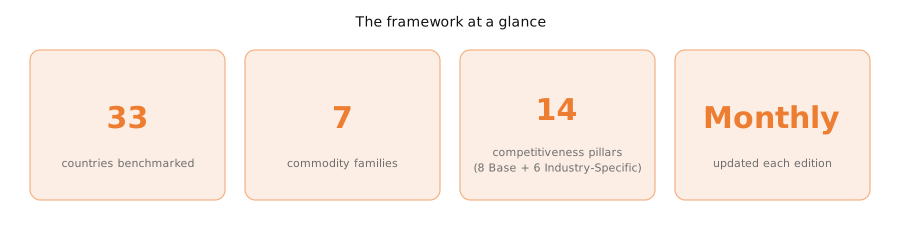
Industry Economics & Competitiveness is a monthly intelligence program on manufacturing competitiveness for non-agricultural commodity industries. It covers 33 countries and 7 industry sectors, delivering structured assessments regenerated each month from the latest available data, so the analysis reflects shifting cost and structural conditions rather than static annual snapshots. Each published edition focuses on one country, presented within a consistent, comparative framework, and serves investors, policymakers, procurement executives, EPCs, cost estimators, and financial modelers.
Three principles govern the program's design:
- Objective measurement: the analysis relies exclusively on verifiable, quantitative data — costs, volumes, rates, macroeconomic metrics, and policies.
- Standardized assessment: identical analytical methodologies are applied across all countries and all months, so cross-country comparisons remain statistically valid.
- Actionable synthesis: complex, multi-dimensional data is distilled into intuitive 0–100 scores and explicit rankings, bridging the gap between raw data and strategic insight.
Those principles resolve into a fixed measurement frame, summarized below.
What does "competitiveness" mean in this report?
Competitiveness is the relative cost and structural advantage of producing a given commodity in one country versus the others in the benchmarking set. Lower production cost and stronger structural conditions mean higher competitiveness. The measure is comparative rather than absolute: a country is always positioned against the full set of peers, not against a fixed external standard, so a score describes standing within the 33-country set rather than an absolute investment threshold. This relative logic is what the pillars translate into a 0–100 score: each pillar isolates one driver of competitiveness, such as labor or energy cost, and the pillars combine into the country's overall position, so the same comparative logic runs from the pillar level up to the overall score.
Which commodities and industries does the report cover?
The report covers seven commodity families, each treated as a distinct industry: Olefins & Derivatives, Aromatics & Derivatives, Alcohols & Organic Acids, Polymers, Fertilizers, Inorganic Chemicals, and Metals. Together these non-agricultural, commodity-based sectors form the upstream and midstream nodes of almost all global value chains. Because the selected commodities are highly commoditized, their local pricing and margin dynamics serve as sensitive barometers of a country's structural manufacturing costs. Sector-level competitiveness is evaluated based on the dominant production technology route used in the focus country (for example, naphtha-based versus ethane-based cracking).
How many countries are scored individually?
The report scores 33 countries individually, forming a fixed benchmarking universe held constant across editions. Each published report focuses on a single country and benchmarks it against the other 32, so month-to-month and country-to-country comparisons stay consistent over time. The 33 countries span four Intratec world regions — Americas, Europe, Asia, and Africa & Middle East — and together account for more than 80% of global manufacturing output, combining mature industrial hubs, resource-rich exporters, and emerging supply-chain nodes.
What is the difference between a pillar, a score, and a reference dataset?
A pillar is one dimension of competitiveness, such as labor or energy, evaluated on a 0–100 basis. The framework uses 14 pillars: 8 Base Pillars shared across all commodities and 6 Industry-Specific pillars defined per commodity family (see the Pillar Architecture page). A score is the 0–100 value summarizing performance on a pillar or overall, where 50 represents the global mean and higher values indicate greater competitiveness. A reference dataset is an absolute-value dataset, such as actual costs or indexes, provided alongside the scores but outside the 0–100 framework (see the Reference Datasets Overview page). In short, scores answer the strategic relative question — how competitive is a country versus its peers — while reference datasets answer the tactical absolute question — what something actually costs.
How was the 33-country set chosen?
Summary
The 33 countries were selected to capture the core of the worldwide industrial economy: together they account for more than 80% of global manufacturing output, with enough statistical depth and geographic diversity to make the 0–100 scores meaningful.
The benchmarking universe is a curated selection, not an open-ended list. It combines three complementary profiles: mature, high-income industrial hubs (such as the United States, Germany, and Japan), major resource-rich exporters (such as Saudi Arabia and Canada), and dynamic emerging supply-chain nodes (such as Mexico, India, and Brazil). This mix ensures the set spans critical raw material exporters, major conversion hubs, and primary end-consumer markets across all major trade blocs.
The size of the set matters methodologically: 33 countries provide a robust, statistically significant baseline for establishing what constitutes "average," "leading," or "lagging" performance — the distribution against which every score is normalized.
The selection spans four Intratec world regions, mapped below.
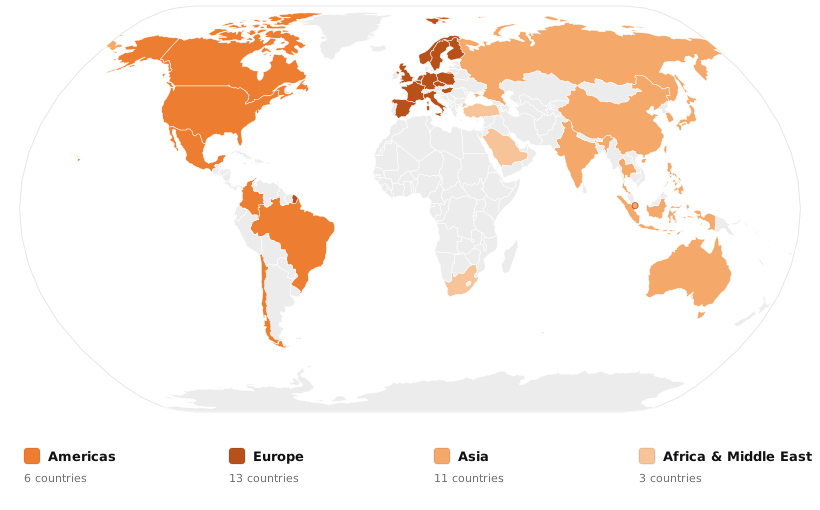
Detailed per-plan country coverage is documented in the Intratec Help Center.
How is the competitiveness analysis validated?
Validation is the final stage of a fixed monthly data path. Each figure begins as data collected from outside sources, is prepared and aligned to a common basis of currency and units so values are comparable across the 33-country set, and only then enters validation before the scores and reference datasets are published. Every published figure passes through the same two-layer validation applied across all Intratec solutions: automated checks on the full dataset, plus human expert review of a representative, risk-guided sample. The full process — including how anomalies are flagged and how accuracy is tracked over time — is described in the Validation & Accuracy section.
