
The 14-Pillar Architecture
What is a pillar?
A pillar is one distinct dimension of industrial competitiveness — a thematic group of related metrics, such as labor costs, energy and utilities, or the tax environment, synthesized into a single 0–100 score. Each pillar isolates one driver of a country's standing so it can be measured, scored, and compared on its own terms, and each pillar has a dedicated chapter in the report. Together, the pillars form the structural backbone of every assessment in the report: pillar scores roll up into industry-level and country-level composites.
Why measure competitiveness through pillars, not one number?
Industrial competitiveness is shaped by many independent drivers — cost structures, infrastructure endowment, macroeconomic stability, market scale, and fiscal conditions — and a single overall figure conceals where a country is genuinely strong or weak. Pillars expose the structure behind a ranking: each one scores a separate driver on the same 0–100 scale, with a higher score always indicating a more competitive position, so a reader can trace exactly why a country places where it does and compare individual drivers across countries.
A single composite also cannot distinguish conditions that apply to all industries from economics specific to one sector. The two-layer pillar architecture keeps these apart: Base pillars capture the country's structural operating environment, while industry-specific pillars capture sector economics such as input prices, conversion margins, and tariff exposure. Decomposing performance into separate, comparable drivers — rather than collapsing it into one value — is what makes the index transparent and actionable.
A country may score well above the global mean of 50 on Energy & Utilities Costs while scoring poorly on Logistics & Infrastructure. An overall figure would average these into an unremarkable mid-range number; the pillar view shows that the country is a cheap place to run an energy-intensive plant but an expensive place to move product to market.
How many pillars does the report use?
The report uses 14 pillars in total: 8 Base Pillars plus 6 Industry-Specific pillars, the latter evaluated separately for each of the 7 industry sectors covered. Every pillar score is built through the same bottom-up aggregation hierarchy: observed metrics in absolute units are normalized across the 33-country universe into 0–100 indicators, indicators are grouped into components, components are synthesized into the pillar's final 0–100 score, and pillar scores combine into industry-level and overall composites.
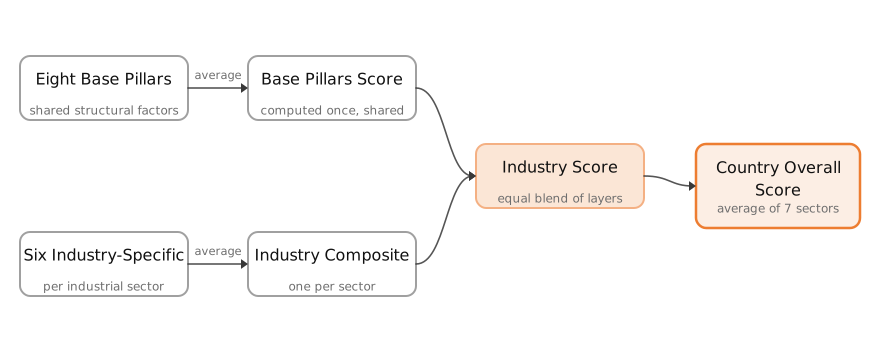
From the pillar level upward the combination logic is simple and stated openly: pillar scores are averaged at equal weight into the Base Pillars Score and the Industry Composites, and the two layers combine at equal weight into the Industry Scores and the Overall Score.
The internal parameters used to synthesize indicators and components into a pillar score are not disclosed; structure, scale, and combination logic are stated openly.
How are pillars split into Base and Industry-Specific?
Summary
The 14 pillars divide into two layers: 8 Base Pillars that score the country's structural operating environment once, shared by all industries, and 6 Industry-Specific pillars scored separately for each of the 7 industry sectors.
The 8 Base Pillars capture conditions that apply equally to all industries: Manufacturing Labor Costs, Construction Labor Costs, Capital & Construction Costs, Energy & Utilities Costs, Logistics & Infrastructure, Freight Costs, Macroeconomic Environment, and Domestic Tax Environment.
The 6 Industry-Specific pillars capture sector-specific economics, evaluated separately for each of the 7 industry sectors (Olefins & Derivatives, Aromatics & Derivatives, Alcohols & Organic Acids, Polymers, Fertilizers, Inorganic Chemicals, and Metals): Commodity Prices, Feedstock-to-Product Margins, Industrial Production, Global Trade Integration, Tariff Protection & Market Access, and Domestic Market Size.
The two layers then combine in four steps: the eight Base Pillar scores are averaged at equal weight into a single Base Pillars Score, computed once per country and reused identically across all seven sectors; the six Industry-Specific pillar scores for each sector are averaged at equal weight into an Industry Composite; for each sector, the shared Base Pillars Score and the Industry Composite combine at equal weight into the Industry Score, the central index output; and the Overall Score combines the Base Pillars Score with the Industry-Specific Pillars Score (the equal average of the seven Industry Composites) at equal weight. This 50/50 structure is the explicit design assumption that structural conditions and sector-specific economics are treated as equally important — neither layer dominates competitiveness in isolation. Each Industry-Specific pillar also produces a cross-industry view — its equal average across the seven commodity families — computed separately from this main four-stage chain and available as a standalone pillar-level score.