

Base Pillars
Which pillars apply to every commodity family?
Summary
Eight Base Pillars — covering labor, capital, energy, logistics, freight, macro-economics, and tax — are each scored once per country on the 0–100 scale, then averaged at equal weight into a single Base Pillars Score shared across all seven commodity sectors.
The Base Pillars are eight cost-and-conditions themes evaluated for all 33 countries, regardless of the commodity being analyzed. They capture a country's underlying manufacturing environment — the inputs and conditions shared by any process plant — so that results stay comparable across all covered commodity families. Lower costs and stronger conditions translate into a higher score (see the Scores and Ranks page for how values are normalized).
Each Base Pillar is scored once per country — independent of the commodity in question — on the common 0–100 scale, with each metric taken as a twelve-month average and normalized against the 33-country universe so that 50 marks the global mean. Most pillars use a twelve-month average of the underlying indicator, smoothing month-to-month noise. Tax rates and tariff schedules change by policy decision rather than continuously, so the Domestic Tax Environment and Tariff Protection & Market Access pillars normalize against the current period's value rather than a trailing average. The eight pillar scores are then averaged at equal weight into the Base Pillars Score, which is shared across all seven commodity sectors.
What do the labor and capital/construction pillars cover?
Summary
Three pillars measure the cost of placing and staffing a plant. Both labor pillars start from the same component build-up — Direct Pay plus Indirect Pay — and scale to a productivity-adjusted cost per effective hour. The Capital & Construction Costs pillar combines a material component with a construction-labor component, then applies two near-neutral adjustments before expressing the result against the United States at 1.00.
Three pillars address the cost of standing up and staffing a plant, and the two labor pillars share one principle: a low headline wage is not enough on its own — what matters is the total cost an employer bears for an effective hour of work.
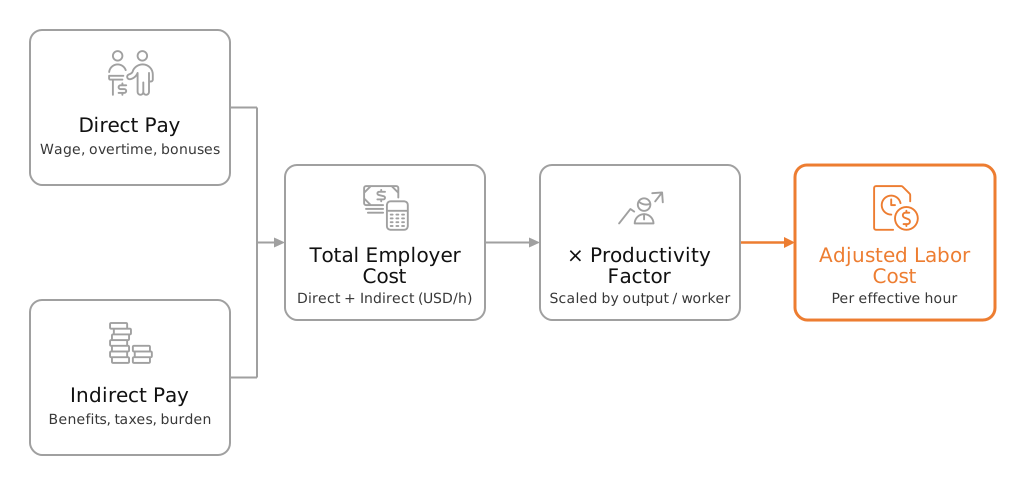
The Manufacturing Labor Costs pillar scores the productivity-adjusted cost of factory labor. The cost build-up runs in four steps:
- Direct Pay — base wages, overtime, bonuses, and allowances paid directly to the worker.
- Indirect Pay — voluntary and customary benefits (health insurance, training, and housing) plus legally required contributions and employer taxes: paid leave, retirement and social-security contributions, unemployment insurance, workers' compensation, and payroll taxes.
- Total Employer Cost per hour — Direct Pay plus Indirect Pay, the complete per-hour cost before adjustment.
- Adjusted Labor Cost per effective hour — Total Employer Cost scaled by a country-level productivity factor (manufacturing value added per employee, anchored to the United States at 1.0×); lower adjusted cost scores higher.
The factor rises linearly from 1.0× at the most productive anchor to 3× at the low end of the productivity distribution, so weak output per worker is penalized heavily — a high-wage, high-output country can out-compete a low-wage, low-output peer.
The Construction Labor Costs pillar applies the same build-up to the trades that erect an industrial facility:
- Direct Pay — base wages, overtime, bonuses, and allowances.
- Indirect Pay — voluntary and customary benefits plus legally required contributions and employer taxes.
- Total Employer Cost per hour — Direct Pay plus Indirect Pay, scoped to construction-trade roles.
- Adjusted Construction Labor Cost per effective hour — Total Employer Cost scaled by a construction productivity factor anchored to the United States at 1.0×.
The factor spans a wider range — from 1.0× to 5× — than the manufacturing factor, reflecting greater cross-country variance in construction-sector output per worker. Construction labor often runs 30–50% of a plant's installed capital cost, so it shapes project economics and payback as much as the equipment itself.
The anchor points for both productivity factors — the most productive and least productive positions on the scale — are calibrated against a broader set of economies than the 33 that receive scores, providing a more stable statistical foundation for the scale.
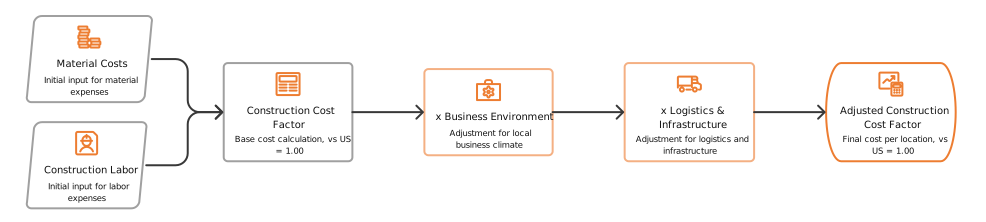
The Capital & Construction Costs pillar measures the full delivered cost of building a complete process plant, expressed against a reference country (the United States = 1.00). The build-up runs in two stages:
Two primary cost components form the base cost factor:
- Material — domestically sourced inputs such as steel and cement plus imported machinery, each carrying its ex-factory price, freight and insurance, and any applicable duties.
- Construction Labor — local crews plus the premium for importing skilled labor where local execution capacity is thin.
Two near-neutral adjustments are then applied to that base factor:
- Business-environment adjustment — regulatory quality, government effectiveness, and corruption exposure.
- Logistics-and-infrastructure adjustment — the cost and reliability of moving goods.
The result is an Adjusted Construction Cost Factor: below 1.00 is cheaper to build than the United States; above 1.00 is more expensive.
A country with very low wages but weak output per worker can still score poorly on the labor pillars: the productivity factor multiplies its low headline wage back up toward — or past — that of a higher-wage, higher-output peer.
What does the energy and utilities pillar cover?
Summary
The Energy & Utilities Costs pillar blends two components — a consumption-weighted average energy price and the modeled cost of ten core process utilities — into a single 0–100 score; energy pricing is the larger component, and lower cost on either side raises the score.
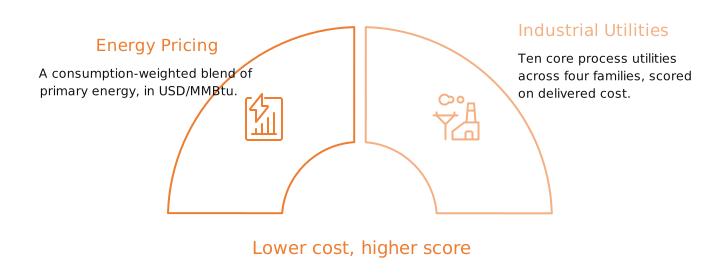
Two cost components feed the Energy & Utilities Costs pillar, where a higher score means a cheaper, more competitive environment. Energy and utilities are among the largest controllable operating costs for chemical and petrochemical production, so they shape margins, process selection, and project viability.
- Energy pricing (the larger component) — the consumption-weighted price of the primary energy a plant buys: electricity, natural gas, and coal, standardized to a common unit (USD per MMBtu) so countries and fuels compare directly.
- Industrial utilities — the ten core process utilities a plant draws on, spanning four families: steam; water utilities (cooling, chilled, demineralized, and process water); atmospheric gases (compressed air, nitrogen, and oxygen); and industrial process gases (hydrogen and carbon monoxide). Each utility is measured in its native unit and scored against the global distribution.
Lower costs on either component raise the score.
Because energy-intensive chemistry lives or dies on these costs, a strong score is a real edge for the most power- and steam-hungry processes; the weaker of the two components tends to be the binding constraint.
What do the logistics and freight pillars cover?
Summary
Two pillars cover the movement of goods: Logistics & Infrastructure scores the capacity and efficiency of the networks themselves (five components, with inland transport carrying the greatest weight), while Freight Costs scores the price of shipping (maritime and inland rates, with ocean freight carrying the greater weight).
Two pillars address the movement of goods, from different angles: one scores the infrastructure that carries freight, the other the cost of the freight itself.
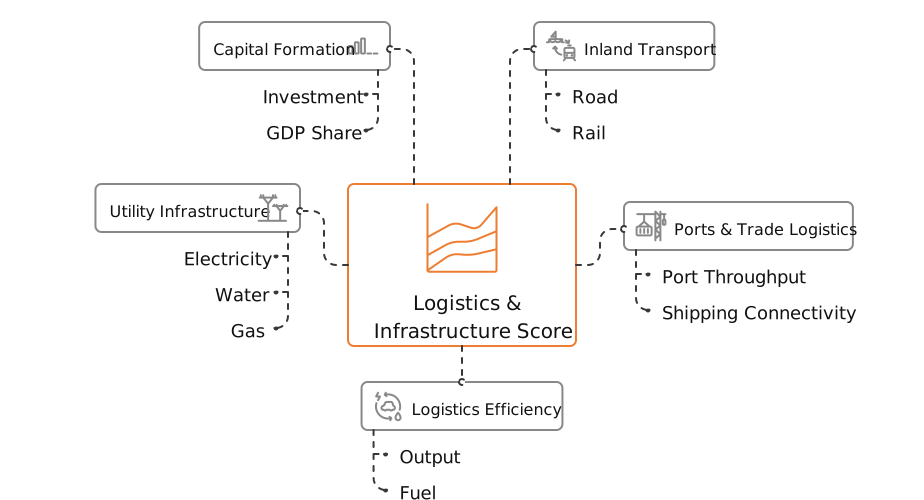
The Logistics & Infrastructure pillar benchmarks the physical scale and operational performance of the networks industrial supply chains depend on, across five components:
- Inland Transport — road and rail freight throughput and network density. Inland transport carries the greatest weight within this pillar.
- Ports & Trade Logistics — maritime gateway strength: container-port throughput and integration into global shipping lanes (for landlocked countries this component is dropped and its weight redistributed across the others).
- Logistics System Efficiency — economic output per unit of transport fuel, a proxy for how little friction the system carries.
- Utility Infrastructure — the scale and reach of the electricity, water, and gas networks serving industrial sites.
- Infrastructure Investment — gross fixed capital formation as a share of GDP, signalling whether the infrastructure base is being maintained and expanded.
A higher score means a more capable, lower-risk environment; this pillar also feeds the logistics adjustment in Capital & Construction Costs.
The Freight Costs pillar measures the cost of shipping itself, combining maritime and inland transport rates, with rates inverted so the lowest-cost countries score highest. Maritime freight carries the greater weight within this pillar, reflecting its outsized role in commodity trade. Maritime rates are taken across cargo categories — containerized goods, dry bulk, liquefied gases, and bulk light liquids — in both import and export directions, anchored to each country's main traded commodity and principal trading partner; categories that do not apply are disregarded. Inland freight blends road and rail rates by each mode's share of actual freight volumes.
The relative weightings of the components within each pillar are part of the undisclosed model; structure, scale, and combination logic are stated openly.
What do the macroeconomic and tax pillars cover?
Summary
The Macroeconomic Environment pillar scores six stability and financing dimensions (price stability and short-term financing cost carrying the greatest weight), while the Domestic Tax Environment pillar combines three fiscal charges with import duties on machinery — both scored from current-period values against the 33-country distribution.
Two pillars frame the broader operating context — the stability of the economy and the weight of the state on a manufacturer's costs.
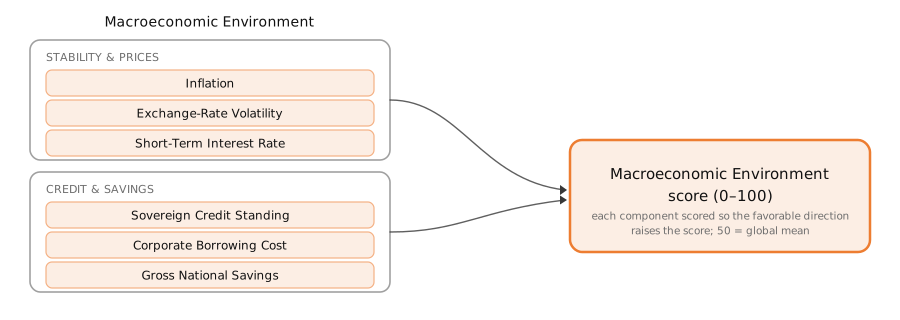
The Macroeconomic Environment pillar scores the stability and financing conditions a country offers long-term industrial capital, across six components:
- Inflation — a moderate, stable level scores best; both deflation and high inflation are penalized.
- Exchange-rate volatility against the US dollar — steadier currencies score higher.
- Short-term interest rate — the cost of working capital.
- Sovereign credit standing — mapped onto a numeric scale, driving every borrower's country-risk premium.
- Corporate borrowing cost — investment-grade corporate bond yield, proxying long-term financing cost.
- Gross national savings as a share of the economy.
Price stability and short-term financing cost carry the greatest weight within this pillar. A higher score means lower investment risk and cheaper capital.
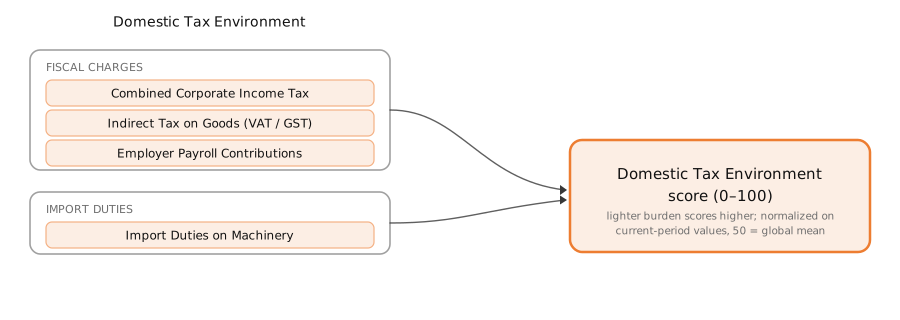
The Domestic Tax Environment pillar scores the tax and trade-policy burden on manufacturing, with burdens inverted so the lightest-taxed countries score highest. It combines three fiscal charges with import duties on machinery:
Fiscal charges:
- Combined corporate income tax rate.
- Indirect tax on goods — VAT, GST, or equivalent.
- Employer payroll contributions.
Plus import duties on machinery — the tariffs levied on imported capital equipment.
Because tax rates move in policy steps rather than gradually, this pillar scores from current-month values rather than the twelve-month average used by most other pillars. Scores are relative to the current global distribution, so a country's standing reflects its position against peers rather than an absolute threshold.
A country can pair a light tax regime with heavy protective tariffs on imported machinery; the two partly offset, so its Domestic Tax Environment score lands between what either alone would imply.