

Industry-Specific Pillars
Which industries and commodities does the report cover?
Summary
Seven commodity families, each tracked through a representative basket, are combined at equal weight — within a family, then across families — into every Industry-Specific pillar score.
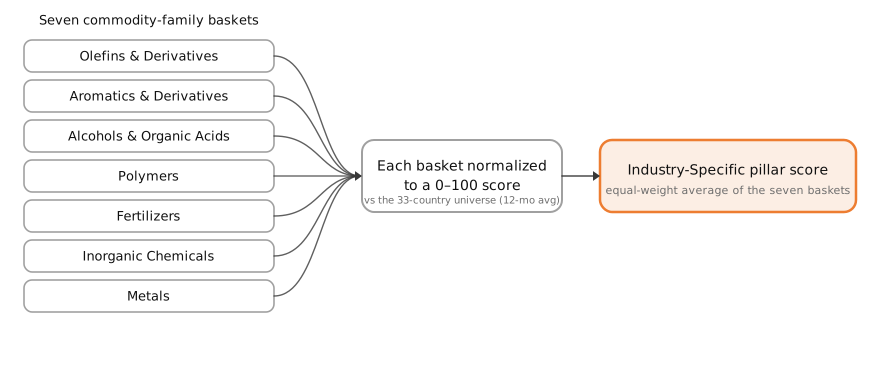
The Industry-Specific pillars cover seven commodity families. Within each family a representative basket of commodities is tracked across all 33 countries; the basket scores are combined at equal weight into the family score, and the seven family scores are combined at equal weight into each pillar's score.
This structure — equal-weight averaging within families, then equal-weight averaging across families — ensures no single commodity dominates the pillar score.
Which pillars change by industry?
Summary
Six pillars are scored separately for each commodity family, on the same 0–100 basis as the Base Pillars, because each industry's economics differ.
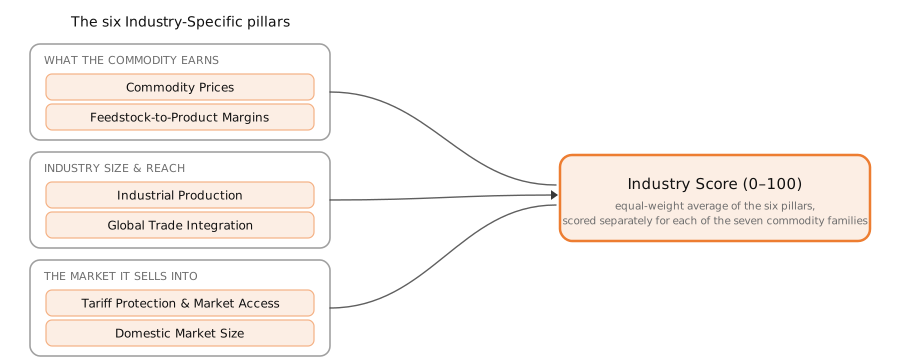
Six of the report's pillars are Industry-Specific: their scores are calculated separately for each of the seven commodity families — Olefins & Derivatives, Aromatics & Derivatives, Alcohols & Organic Acids, Polymers, Fertilizers, Inorganic Chemicals, and Metals — because the economics of each industry differ. Each pillar is scored on a 0–100 scale, with the same direction as the Base Pillars: better conditions yield higher scores. The six pillars group into three themes: Commodity Prices and Feedstock-to-Product Margins cover what the commodity earns, Industrial Production and Global Trade Integration cover industry size and reach, and Tariff Protection & Market Access and Domestic Market Size cover the market it sells into.
Each Industry-Specific pillar is built the same way. Within every commodity family a representative basket of commodities is tracked; each basket is normalized to the 0–100 scale against the 33-country universe on a twelve-month average (current-month for Tariff Protection & Market Access); and the seven family scores are then averaged at equal weight into the pillar's score for that sector.
What do the commodity prices and feedstock-margin pillars cover?
Summary
Commodity Prices reads input-cost advantage (lower delivered prices score higher); Feedstock-to-Product Margins reads conversion economics (wider product-minus-feedstock spreads score higher).
Both pillars read the economics of a commodity chain, from opposite ends.
The Commodity Prices pillar measures the delivered price of a country's key industrial feedstocks — the largest single cost for most commodity chemicals, polymers, and basic materials. For each industry family a representative basket is tracked in USD per tonne (export prices on an FOB basis, import prices adjusted to landed cost for freight, insurance, and duties, with regional benchmarks bridging gaps), averaged over twelve months and normalized to the 0–100 scale. Prices are inverted, so the lowest-cost countries score highest: a high score signals a structural input-cost advantage.
The Feedstock-to-Product Margins pillar measures what a plant earns converting feedstock into product: the USD-per-tonne spread between the product price and the cost of the feedstock it consumes, assessed for the dominant production route in each country — for example, ethylene from ethane or naphtha for olefins, ammonia from natural gas or coal for fertilizers, or hot-rolled coil over the ore-or-scrap basket for metals. Wider positive spreads score higher, because they leave more room to cover conversion cost and capital service.
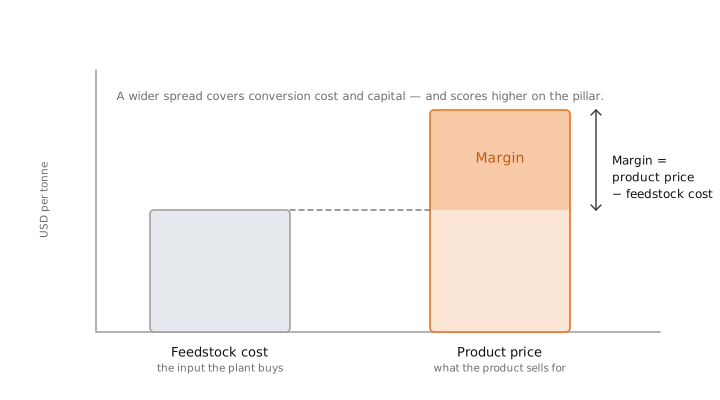
A country with cheap local feedstock but depressed product prices can score well on Commodity Prices yet poorly on Feedstock-to-Product Margins — low input cost alone does not guarantee a profitable conversion spread.
What does the industrial production pillar cover?
Summary
Industrial Production scores physical output scale — larger volumes signal industrial depth and economies of scale. It gauges capacity, not profitability.
The Industrial Production pillar captures the physical scale of a commodity industry within a country — output volumes for the representative commodities in each family, measured in tonnes or energy-equivalent units, averaged over twelve months and normalized to the 0–100 scale against the 33-country universe. Larger output scores higher, signaling industrial depth, mature infrastructure, and economies of scale.
The pillar gauges capacity, not profitability or price, so it is best read alongside the cost and trade pillars: large-scale production can coexist with tight margins or limited export access, and scale alone does not guarantee competitiveness. A score above the mid-range points to broad, high-volume production across the chain; a low score points to narrow, small-scale, or import-dependent output.
What do the trade integration and tariff protection pillars cover?
Summary
Global Trade Integration rewards broad, diversified trade flows; Tariff Protection & Market Access weighs home protection against export-market access, with reaching foreign markets counting for more.
The Global Trade Integration pillar measures how deeply and how widely a country participates in global trade for the industry's commodities, across five dimensions:
- Export value — the scale of outward trade flows.
- Import value — the scale of inward trade flows.
- Trade openness — combined flows relative to the size of the economy.
- Export-partner diversification — how widely export partners are spread.
- Import-partner diversification — how widely import partners are spread.
Broader, more diversified flows score higher: scale brings market reach, and partner diversification brings resilience against a single-market disruption.
The Tariff Protection & Market Access pillar reads the trade-policy environment from two sides — the protection local producers enjoy at home (the average tariff the country applies to imports in the industry, weighted by its import volumes) and the access their exporters have abroad (the average tariff faced in destination markets, weighted by export volumes, where lower tariffs faced score higher). Export market access carries greater weight in this pillar than domestic import protection. For the export-exposed commodity industries the report covers, the ability to reach global markets drives long-run plant economics more than tariff shelter at home. Both pillars are averaged over twelve months and normalized to the 0–100 scale.
The component weightings within each pillar are part of the undisclosed model; structure, scale, and combination logic are stated openly.
What does the domestic market size pillar cover?
Summary
Domestic Market Size measures apparent consumption — local production plus imports minus exports — so larger home markets score higher.
The Domestic Market Size pillar measures in-country demand for the commodity — its apparent consumption, that is local production plus imports minus exports — for the representative commodities in each industry family. A larger home market scores higher: it lets a project sell locally at scale, capture economies of scale, and lean on nearby supplier ecosystems rather than depending entirely on exports.
Demand is averaged over twelve months and normalized to the 0–100 scale against the 33-country universe, with the same direction as the other pillars: larger, deeper markets score higher. Because absolute scale anchors the score, very large economies can rank well even where per-unit consumption is moderate, while small markets are capped by limited size regardless of affluence.