

Freight & Insurance
Freight Assessments
What are maritime freight assessments?
Maritime freight rates represent the cost of shipping energy commodities along international sea trade routes. For landlocked countries, the maritime freight figures refer to the port in a nearby country through which goods are typically shipped by sea. Figures cover maritime transportation only and do not include transport between the port and the country.
Each assessment is built for a specific combination of trade route and commodity category — energy commodities are grouped by physical and chemical properties (heavy oils, liquid fuels, hydrocarbon gas liquids, liquefied natural gas, and coal products) so that the assumed vessel type matches how the commodity is actually shipped. Freight rates are then produced through one of two modeling approaches, compiled or estimated, depending on how much trade data the route generates.
What freight categories are used?
Because similar vessel classes often carry different energy commodities, fuels are categorized by their physical and chemical properties — which drive handling, storage, and shipping requirements — ensuring compatibility with freight types (tankers for liquids, bulk carriers for solids).
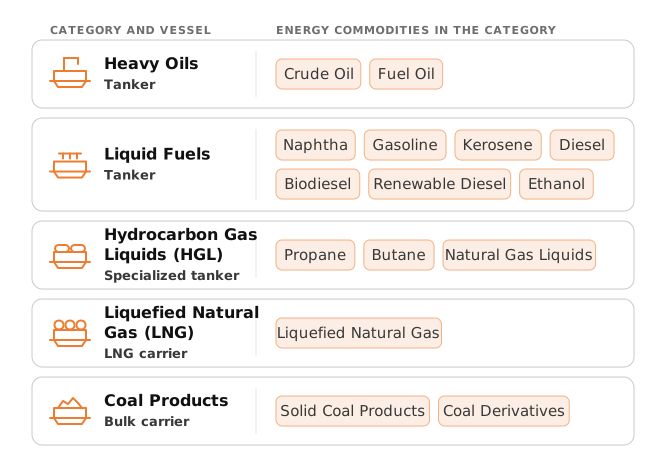
Freight assessments divide into two types based on how they are modeled: compiled and estimated.
How are compiled and estimated freights modeled?
Freight assessments split into two modeling approaches depending on how well-traveled the route is.
Compiled freights apply to prominent global trade routes where volume and transparency allow raw data to closely reflect actual freight activity. The modeling process follows these steps:
- Data collection — freight data are gathered from public sources, typically as a series of freight rates (cost per unit quantity) collected over a month.
- Formatting — raw public data undergo a formatting step to align with the internal system.
- Statistical validation — anomalies and outliers are detected and removed.
- Aggregation — compiled freights are usually the monthly average of closing values from daily or weekly published freight rates.
- Normalization — the resulting series is directed to normalization.
Estimated freights apply to less prominent trade routes where direct data are limited. Compiled freights from comparable routes serve as a reference and are adjusted proportionally for differences in route distance and time.
Are freight forecasts provided?
Short-term forecasts are available for selected freight assessments. Each forecast is derived from mathematical models that incorporate projected data across three inputs:
- Freight costs for related routes
- Prices of relevant commodities (e.g. fuels)
- Economic indicators
Each forecast reflects the most likely scenario over the next six months as of the latest update. Forecasts are refreshed on the same monthly cycle as every other Intratec assessment, so the six-month outlook always extends from the most recently published edition. The projected freight and insurance costs then extend the freight-based price approach forward, so netforward and netback prices can be calculated for future periods as well as the current one.
Insurance
How are insurance costs assessed?
Insurance covers the risks of cargo transport, protecting shipments against potential losses. Insurance costs are calculated as a percentage of the CFR (Cost and Freight) price, with the percentage varying by commodity.
The percentage for each commodity is derived from international trade information reported by countries for each traded good. These data are gathered and transformed to store the information needed to estimate insurance costs. The final percentage is the average of selected data under a combined criterion of data homogeneity, minimum volume, and gross-outlier removal.
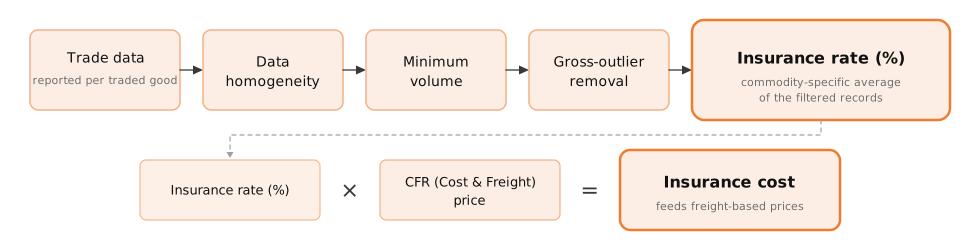
Once assessed, the insurance cost feeds directly into freight-based price assessments — added to the origin price in a netforward, subtracted from the destination price in a netback — alongside the maritime freight rate.
How are preliminary freight and insurance values handled?
Official foreign trade statistics are often published with a one-to-two-month delay due to confidentiality requirements or processing time. When data are insufficient, inadequate, or unavailable, preliminary assessments are provided. Analysts carefully collect and verify all supporting data and apply suitable mathematical models to produce these estimates.
Preliminary values are marked (P) to distinguish them from consolidated data. Freight and insurance assessments are then directed to normalization and published in accordance with the Information Publication procedures.
These assessed freight rates and insurance costs feed directly into freight-based price assessments — see Freight-based prices in Price Assessments.