

What the Report Covers
Open the Full Methodology (PDF)
What is Energy Prices & Markets?
Summary
A subscription program of monthly reports on energy commodity prices and markets, each edition focused on a single country and built from official trade statistics and computational models rather than subjective market quotes.
Energy Prices & Markets is a subscription-based program that delivers monthly reports on energy commodity prices and markets worldwide. Each edition is dedicated to one country, released early in the month, so the analysis reflects the latest available prices, forecasts, market trends, and trade dynamics. It serves energy traders, procurement and cost-planning teams, risk managers, analysts, policymakers, and investors navigating volatile, fast-moving energy markets.
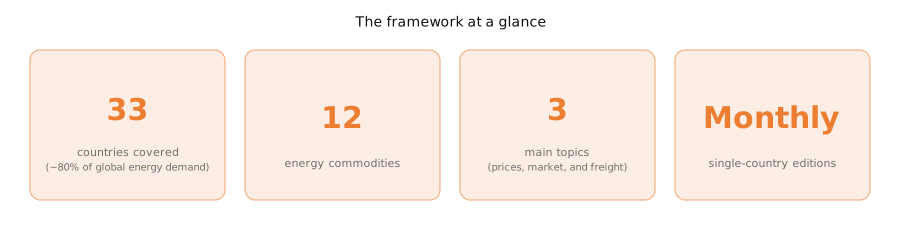
At a glance, the program holds to a fixed scope and cadence: 12 energy commodities assessed across 33 countries through five price-assessment approaches, published as a monthly report dedicated to a single country.
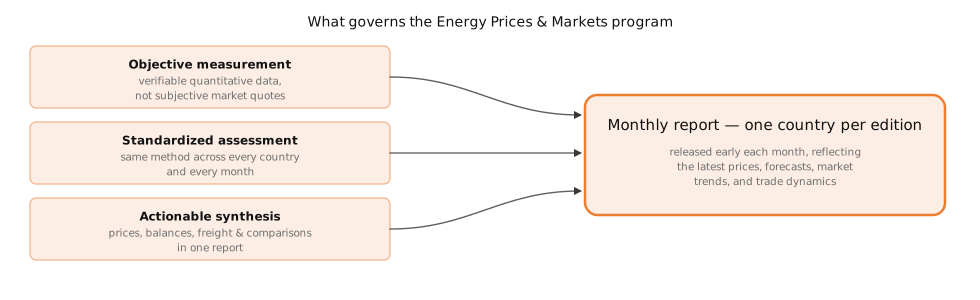
Three principles govern the program's design:
- Objective measurement: assessments rest on verifiable, quantitative data — primarily effectively closed international trade deals reported by official statistics — rather than subjective buyer and seller quotes that reflect expectations rather than actual transactions. This keeps the data transparent, auditable, and unbiased.
- Standardized assessment: the same methodology is applied across every country and every month, so cross-country and month-to-month comparisons remain valid.
- Actionable synthesis: prices, forecasts, energy balances, freight and insurance costs, and global comparisons are organized into a consistent report structure that turns raw data into decision-ready insight.
What questions does each report answer?
Each report is built to answer the essential questions a decision-maker asks about a country's energy market:
- How have energy prices changed historically, and recently?
- What are the price forecasts for energy commodities?
- How do local energy prices compare to global market prices?
- What are the key trends in the country's energy production and consumption?
- How are freight and insurance costs affecting the competitiveness of energy imports and exports?
- To what extent is the country self-sufficient in energy production?
- Which countries are its main energy trade partners, and how reliant is it on energy imports or exports?
- How exposed is the country to financial or supply risks in its energy trade relationships?
The methodology behind each of these answers is detailed across the Price Assessments, Energy Balance & Markets, Freight & Insurance, and Cross-Country Price Comparison pages.
Which energy commodities does the report cover?
Summary
Every report assesses the same 12 energy commodities, spanning primary fossil sources, refined and processed products, electricity, and renewable fuels.
Each report covers a fixed set of twelve energy commodities, so coverage is consistent across countries and editions:
The set spans both primary energy sources — extracted directly from reserves — and secondary energy — products obtained by transforming primary sources into usable fuels and power. For transportation and freight analysis, these commodities are regrouped into maritime cargo categories; see Freight & Insurance.
How many countries are covered?
Summary
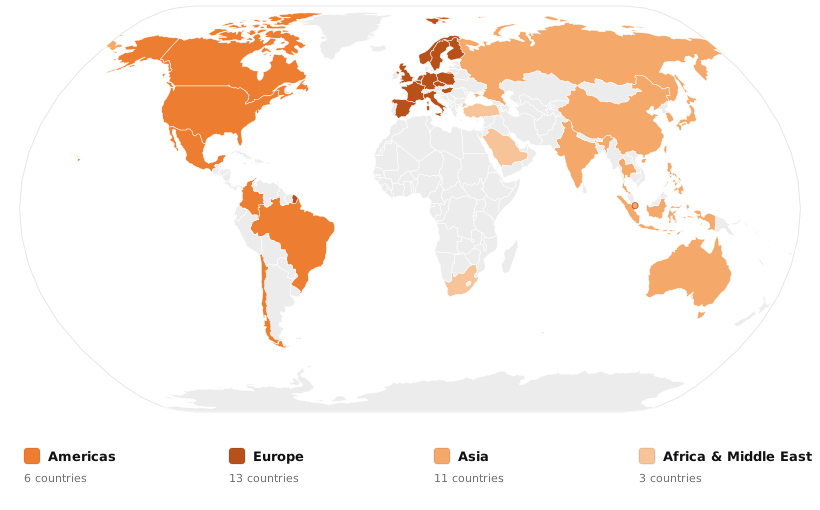
The program covers 33 countries individually, together accounting for around 80% of global energy demand — a set broad enough to capture the markets that drive worldwide supply, pricing, and trade.
Each report focuses on a single country, drawn from a fixed universe of 33. Holding the set constant keeps comparisons consistent from month to month and country to country. The 33 countries span four Intratec world regions:
Detailed per-plan country coverage is documented in the Intratec Help Center.
What does each report contain?
Summary
A consistent set of sections — executive summary, current and historical prices, forecasts, market outlook, and freight and insurance — followed by reference appendices. The depth of each section depends on the subscription plan.
Every edition follows the same structure, so a reader always knows where to find each topic:
- Executive Summary — key energy prices and recent market changes at a glance.
- Current Prices — variations from the previous month and year for all assessments.
- Historical Prices — the evolution of energy commodity prices over time.
- Price Forecasts — short-term forecasts for selected price assessments.
- Market Outlook — imports, exports, production, demand, energy balance, and electricity generation by source.
- Freight & Insurance — maritime freight rates and insurance costs for key trade routes, with netback and netforward prices.
- Appendixes — glossary and methodology, currency and unit conversions, model accuracy, global price comparison, and a frequently-asked-questions section.
The scope and depth of these sections vary by subscription plan. Plans, pricing, and per-plan coverage are described in the commercial information page and the Intratec Help Center, not in the methodology.
How is the analysis validated?
Validation is the final stage of a fixed monthly data path: data is collected from outside sources, prepared and aligned to a common basis of currency and units, and only then validated before publication. Every published figure passes through the same two-layer validation applied across all Intratec solutions — automated checks on the full dataset, plus human expert review of a representative, risk-guided sample. The full process, including how anomalies are flagged and how accuracy is tracked over time, is described in the Validation & Accuracy section.