

What These Methodologies Cover
What does this methodology knowledge base explain?
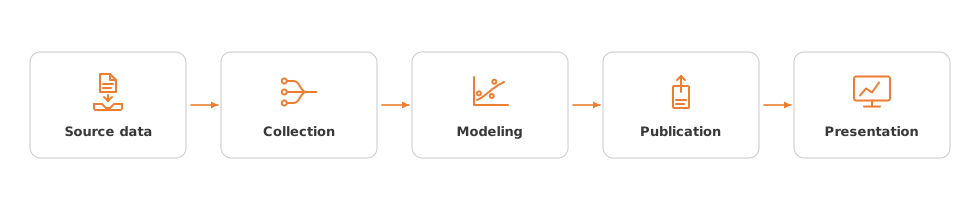
This knowledge base explains how Intratec's data is gathered, transformed, modeled, validated, and published. It also documents how each solution is built on top of that shared data — Energy Prices & Markets (price and market assessments, freight and insurance, cross-country comparison), Commodity Production Costs (capital investment, operating costs, and product value estimates), Primary Commodity Prices (price assessments, forecasts, and data timing), and Industry Economics & Competitiveness (pillars, scores, and reference datasets). The aim is to make every step from raw inputs to finished assessment transparent to readers. That path runs end to end: data is gathered, transformed, modeled, validated, and published, then presented to readers as a finished assessment.
How is the knowledge base organized?
The menu groups the material into twelve sections, ordered from Document Library at the top of the sidebar to Glossary at the bottom. Document Library opens the menu, holding each solution's complete methodology as a single downloadable PDF. Our Framework follows, then three sections cover the data lifecycle from intake to release. Four solution sections then document the methodology specific to individual Intratec solutions — Energy Prices & Markets, Commodity Production Costs, Primary Commodity Prices, and Industry Economics & Competitiveness — and the final three sections cover the principles that keep assessments independent, the published reference literature, and a glossary of recurring terms.
Within Our Framework, the articles run in reading order: the methodology family, core principles, this navigation overview, world regions, currency, units of measurement, and the bridge to plans and coverage in the Help Center.
Where should a first-time reader start?
A first-time reader should begin with Our Framework, which introduces the methodology family, the core principles behind every assessment, and the shared conventions — world regions, currency, and units — used throughout the rest of the site. From there, the From Raw Data to Assessments, Validation & Accuracy, and Publishing & Revisions sections can be read in order to follow the full data lifecycle. Readers focused on a specific solution can move directly to its section — Energy Prices & Markets, Commodity Production Costs, Primary Commodity Prices, or Industry Economics & Competitiveness. All methodology documents are publicly available, with no subscription or login required.
Where are the recurring methodology terms defined?
The Glossary defines every term the methodology uses repeatedly — the price types, the data status labels (Final, Preliminary, and Forecast), the accuracy metrics (mean absolute percentage error, mean absolute percentage accuracy, directional accuracy, and the model performance score), and the pricing conventions (netback, netforward, and the Incoterms that fix each assessment basis). Holding those definitions in one place keeps the meaning of a term identical across every part of the methodology, so no individual article has to repeat or paraphrase a definition inline.