

Product Value
What is the product value?
Summary
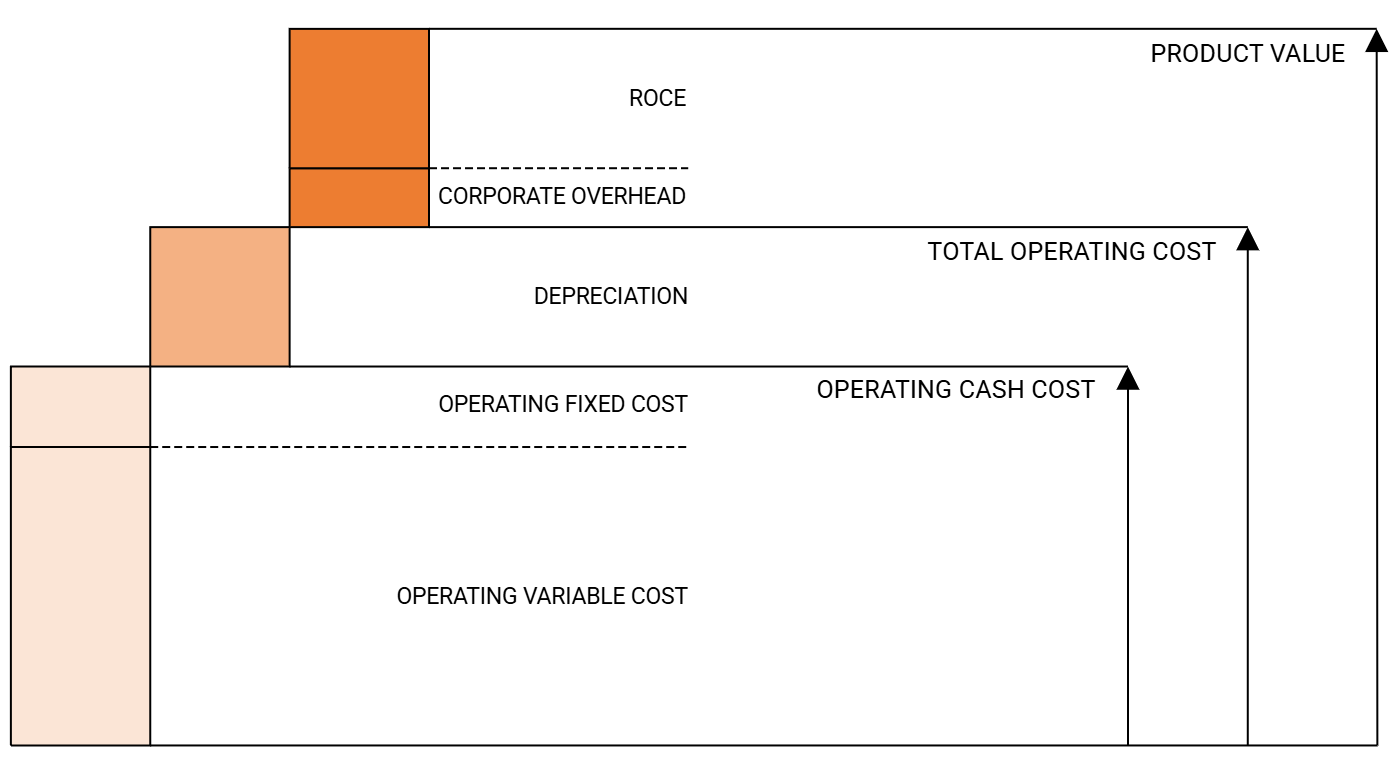
The product value is the datasheet's bottom line — the price a product must sustain for a plant to cover its full cost of production and earn a return on the capital invested. It sums operating variable costs, operating fixed costs, depreciation, corporate overhead, and the expected return, in US dollars per amount of product.
The product value is the final figure of a Commodity Production Costs report — the line that closes the cost cascade in the one-page Production Cost Datasheet. It is the price the product would have to sustain for a plant to recover every cost of production and earn an expected return on the capital invested. It is built from five components:
The first three make up the plant's operating costs;
Is the product value the same as the market price?
Summary
No. The product value is calculated from a plant's costs, overhead, and expected return; the market price is the value actually practiced in market transactions. Confusing the two is the most common misreading of a report.
No — and confusing the two is the most common misreading of a report. The product value and the market price answer different questions:
- The product value is a calculated figure: the sum of operating costs,
corporate overhead , and an expected return on capital. It is what the product must be worth for a plant to cover its full cost of production and earn a target return. - The market price is the actual value practiced in market transactions — what the product is really bought and sold for, set by supply, demand, and negotiation.
Because it reflects the cost of production plus a required return rather than market conditions, the product value works as a minimum-price-style indicator: roughly the level a producer would need to reach to justify the investment. A market price below the product value signals that production would not earn its expected return; a price above it signals headroom. It is not a quote of the current market price, and it is not a forecast — see
Can the product value be used as a price forecast?
No. The product value is not a price forecast. Each report reflects a single period of analysis — one quarter — and states the production economics for that period only, using data already finalized for that quarter. It does not project future prices or costs.
Production Cost Reports contain no forecasts of any kind: every figure describes the quarter analyzed, built from final data rather than from projections. Reports from different quarters can be compared to see how production economics have shifted over time, but each individual figure — the product value included — is a point-in-time estimate, not a prediction of where prices are heading.
What does corporate overhead include?
Summary
Corporate overhead is the company-level cost of doing business beyond the plant itself. It has four components — administration, information technology, marketing & advertising, and research & development — each estimated as a percentage of a defined cost basis.
Corporate overhead covers the head-office costs of running the business that are not directly tied to operating the plant. It is one of the components of product value, estimated in four parts:
The marketing & advertising factor is set by the plant's industry sector:
Research & development varies by sector and by how proven the technology is:
These factors are industry averages. A particular analysis may adopt different assumptions where the specific process or context warrants.
What is the expected ROCE, and how is it set?
Summary
The expected return on capital employed (ROCE) is the return a plant's invested capital is assumed to earn. It enters the product value as a per-product amount — capital costs times the expected ROCE percentage, divided by annual production — and the percentage is set by industry sector and technology maturity, within the 5–25% range typical of a new chemical plant.
The expected return on capital employed (ROCE) is the return the capital invested in a plant is expected to earn, and the last component added to product value. It enters the calculation as a per-product amount:
Expected ROCE amount = capital costs × expected ROCE percentage ÷ annual production
which expresses the cost of the plant's investment in US dollars per amount of product. Most chemical companies aim for a ROCE of 5–25% for the construction of a new plant. The exact percentage assumed in a report depends on the industry sector and on how proven the production technology is — the less mature the technology, the higher the expected return, reflecting greater technical risk:
Here technologies under development are those not yet established on a commercial scale — at the conceptual, embryonic, or emerging stages of the technology maturity scale — while established technologies are the proven ones in commercial use.
What risks does the ROCE assumption cover?
Summary
Only technical risk — the uncertainty in the production process — is reflected in the expected return. Business, market, competition, price, and policy risks are deliberately left out.
The return built into the product value reflects one kind of risk only: the technical risk arising from uncertainties in the production process itself. The less proven the technology, the higher the expected ROCE, because a less mature process carries more technical uncertainty and cost uncertainty.
Several other risks that a real investment decision would weigh are deliberately not reflected in the expected return:
- Changes in the business environment.
- Shifts in the product's market.
- Increased competition.
- Variations in raw-material and product prices.
- Changes in government policy.
Because these are left out, the product value isolates the economics of the process itself, leaving market and policy risk to be judged separately by the reader.
In what units is the product value expressed?
The product value is expressed in US dollars per amount of product — a monetary value per physical unit of output, such as US dollars per metric ton. Reporting it this way puts every report on the same monetary and physical basis, so product values stay comparable across commodities and countries. The currency basis and the way physical quantities are standardized are described in units.